



Opposition Overview: Southend United

Kate Willetts • August 21, 2026

Share this article

Southend United are up next Damson Park on Saturday 22nd August, 12:30 kick-off. 


Looking to bounce back from back-to-back league defeats, The Moors will be facing a tough test from an away side that will no doubt be delighted with their perfect start to the season. The Shrimpers have won their opening two league. A 3-1 away win at 10-man Altrincham was followed by a 1-0 victory at home to Scunthorpe. They currently sit 4th in the National League on 6 points. 


Last season, manager Kevin Maher guided the club to the play-offs, with a 6th placed finish, before been knocked out with a 1-0 loss to Scunthorpe. Maher was then replaced in June by Kieron Dyer, the former Premier League and England International. Their top scorer was former Moors striker Andrew Dallas, while defender Gus Scott-Morris netted a remarkable 15 league goals from right wing-back, earning himself a move to Oldham Athletic in League Two. 


A history of Southend

Pre-1906 to 1949

Organised football in the Borough of Southend-on-Sea started becoming popular late 1890's. Clubs such as Southend Victoria, Southend Amateurs, Southend Corinthians, Southend Ramblers and even Southend Wesleyans were on the local scene at this time.


The clubs colours were white shirts and blue shorts. By 1900 this side has changed its name to Southend Athletic, and although Marine Park was later to become The Kursaal, the ground was different to the one occupied by Southend United in their early Football League days.


It consisted of a railed off pitch surrounded by a 'trotting’ track and a large pavilion with absolutely no spectator accommodation. In 1900 a new pitch was laid out adjacent to the large property in Victoria Avenue called Roots Hall. The face of football in the Borough was to change forever following a meeting held in the Blue Boar Public House on May 19th 1906.


It is well documented that Southend United were formed at this meeting convened by landlord Oliver Trigg and a band of fellow enthusiasts. 


The fledgling club usurped the prominence of the established Southend Athletic club, who were to disband soon after, and gained election to the professional Southern League Second Division. Their opponents were mainly reserve teams but also included the likes of Hastings and St Leonards, Tunbridge Wells Rangers and Salisbury City. The Southern League Division Two title was won twice in succession in the club's first two seasons. Bob Jack's side, led by goal machine Harold Halse and the mercurial inside forward Prince Blott, lost only five matches in that time. In later Southern League campaigns, Blues were forced on long trips to deepest Wales to fulfil fixtures against the likes of Mardy, Treharris and Mid Rhondda. The FA Cup was entered for the first time in 1907 with a match against East Ham. Early ties included games against long lost teams such as London Caledonians, Walthamstow Grange, Southend Amateurs, Custom House and the 4th King's Royal Rifles.


The First World War intervened and Roots Hall’s fixtures and fittings were sold off and the ground requisitioned for allotments to aid the war effort. The wooden 200 seater stand that had been erected on the east side of the ground by a local firm, Ducat's, was dismantled with the wood being given to a local timber yard whose buildings had been damaged by enemy bombs. When hostilities ceased and football resumed in 1919 the Roots Hall site was deemed unusable and Southend United's only option was to move across town to the former Marine Park, now known as The Kursaal.


In 1920 the Southern League clubs, including Southend United, were elected en bloc to form the new Third Division of the Football League. A year later this became the Third Division South as a northern section had also been introduced. The honour of scoring Southend’s first ever goal in the Football League fell to Albert Fairclough. 


Despite having to apply for re-election to the League in only the second season, the Shrimpers really progressed when Ted Birnie became manager in January 1922. He turned a mid table club into one that challenged for promotion, though he never managed to get the club into the Second Division.


Prominent players in the Birnie era were Jim McClelland who was sold to Middlesbrough for a sizable fee, Billy Hick and Jimmy Shankly, older brother of Bill Shankly. One of the most notable matches in this period was the 4-1 trouncing of Second Division leaders Derby County in the FA Cup 4th round at The Kursaal.


Ted Birnie’s departure at the end of the 1933/34 season after twelve years ushered in a new era at the club. The Blues moved across town to the Southend Stadium in Grainger Road which was primarily a greyhound racing track, albeit with a larger capacity than The Kursaal. The old ground was demolished within two years of vacation. The new start also saw David Jack, son of Bob Jack, Southend’s first manager, take over the team. He had been the pre-eminent player of the time, having captained England and winning many honours with Bolton and Arsenal.


The team struggled along in mid-table under Jack although the Blues gave Tottenham Hotspur a fright in the FA Cup of 1935/36, drawing a dramatic game 4-4 at White Hart Lane. The replay at the Stadium was lost 2-1 but the crowd of 23,634 was a new club record.


Among Southend’s best players of the 1930’s were Len Bolan, Billy Moore, Leo Stevens and Irish internationals George McKenzie and Charlie Turner.


The 1939/40 season was abandoned after just three games after the outbreak of war with Germany. David Jack was called to London to work in a bank and after the war took up the manager’s job at Middlesbrough. Southend was a restricted area and the team had to relocate to Chelmsford City’s New Writtle Street ground. City’s manager became manager of both sides, although in war time matches the Southend side was effectively a combined side anyway. 


Harry Warren stayed as manager of Southend when the Blues returned for the 1946/47 campaign. He had put together a useful, free scoring side and in that first season Cyril Thompson, Frank Dudley, Harry Lane and Alf Smirk all hit double figures for goals. 


The club suffered a blip in the 1948/49 season finishing fourth bottom of the table and narrowly missing the dreaded re-election vote. Warren had pulled off a masterstroke that season though, signing Irish midfield maestro Jimmy McAlinden who was to prove to be the fulcrum of the team for several seasons. The following campaign with “Jimmy Mac” in imperious form saw the Shrimpers challenging for promotion all season. However, a disastrous run of no wins in the last four games saw the team miss out finishing third behind Notts County and Northampton Town.


1950 - 1959

Southend United headed into the 1950’s with the considerable optimism that gripped post-war Britain. In April 1950 Sandy Anderson joined the club from Newburgh Juniors and became a defensive stalwart for 12 seasons. He made 452 league appearances for the Blues; no man has played more. His overall total of 483 matches was only beaten in the 1980’s by Alan Moody.


Crowds soared and under the consistent, long-term management of Harry Warren, the Blues entered a period where high-scoring matches were a regular occurrence. At Southend Stadium in February 1951, Southend found themselves 2-0 down to Swindon Town early in a game. It was down to inspirational captain, Jimmy McAlinden, that the team galvanised themselves, completely swamping the visitors and winning 8-2.


A season later the FA Cup proved a highlight with an impressive run to the fifth round. Bournemouth, Oldham, Southampton and Bristol Rovers had been dispatched in the previous rounds with sixteen goals being scored. A crowd of nearly 22,000 gathered at the Stadium for the visit of Second Division Sheffield United. Despite taking the lead through Albert Wakefield, the Shrimpers bowed out of the competition by a score of 2-1.


Towards the end of 1953/54, a heartfelt standing ovation at the Stadium saw Southend say goodbye to its retiring captain, Jimmy McAlinden. In February 1953 Warren signed a gangly, skinny centre forward from Tottenham Hotspur reserves. The signing of Roy Hollis was a masterstroke as he went on to score 135 goals in six years with the Blues. His record tally still stands today.


The 1955/56 campaign was to prove one of the most pivotal in the club’s history. After 21 years at the largely unpopular Southend Stadium, the Blues moved into their new home. The new Roots Hall had been built entirely by internal labour with Sid Broomfield leading a small band of men to build the stadium we know and love today. The entire cost of the stadium, save for a small grant from the Football Association, was met by the Supporters Club and their extensive fund-raising programme.


The opening day fixture against Norwich City attracted 17,700 to the new stadium, built on the site of the old Roots Hall ground the club had used between 1906 and 1915. The move had the desired effect, home league crowds averaged in excess of 10,000, some 2,500 up on the last campaign at Grainger Road.


The season ended on a low however when after sixteen years in charge of the club Harry Warren left for an ill-fated spell at Coventry City. Welshman Eddie Perry took over at the helm and failed to win any of his first ten games in charge. However, he steadied the ship and guided the club to three top ten finishes in Division Three without ever really challenging for promotion.


It was a shame that promotion could not be achieved as Southend boasted some excellent players in this era. Arthur Williamson, a consistent Scottish full-back who played in a record 229 consecutive matches for the club. There was also the likes of Sam McCrory who was capped by Northern Ireland, John McGuigan, Jimmy Stirling and Lou Costello. Eccentric goalkeeper Harry Threadgold was a crowd favourite although the addition of floodlights at Roots Hall in 1959 would restrict his appearances as he claimed he struggled to see the ball under the lights


1960 to 1969

Eddie Perry would leave his post at the club in February 1960 so the Blues would enter the new decade looking for a new manager.


The club finished the 1960/61 campaign with chairman Major Alf Hay MBE selecting the team, finishing mid-table, although Duggie Price enjoyed a very successful campaign, claiming 28 league goals in 41 games.


For the first season of the new decade, the club appointed Frank Broome as manager. He had a decent pedigree as a winger with Aston Villa and England and had cut his managerial teeth at Exeter. The board only offered him a week to week contract though and restricted him to just five new players in the close season. Prolific scorer Roy Hollis had moved on and Broome replaced him with Jim Fryatt. However, Broome did land a brilliant signing in young outside-left John McKinven from Raith Rovers. He would thrill Roots Hall for the best part of a decade.


Broome’s tenure however was markedly shorter than Perry's or Warren's, by Christmas he was gone. Major Hay took the reigns again until the club secured the services of Ted Fenton towards the end of the season. The team finished 20th, surviving relegation to Division Four by a single point.


After the controversy of white home shirts for the previous two seasons the club reverted to blue shirts for the 1961/62 season, albeit with a white pinstripe. Tony Bentley, who would spend 12 years with the club, joined from Stoke City. The Blues would improve steadily under Fenton and in the 1962/63 campaign, despite the worst winter weather on record, climbed to a respectable eighth in the final table, and Ken Jones top scored for the second season running.


Despite an influx of new players for the 1963/64 season in the form of Jimmy Conway, Benny Friel, Bobby Gilfillan, Bobby King and Malcolm Slater. the Blues struggled to gel and finished in the bottom half. A poor season was highlighted by an FA Cup first-round exit at the hands of non-league Yeovil Town. The club ended the season with significant debts of £42,000 with gates down by an average of 1,500 people per game.


Fenton left the club at the end of the 1964/65 campaign - another mid-table finish resulted in the board deciding on fresh ideas. The new man at the helm was fiery Welshman Alvan Williams, a man who in later life would be charged with attempted murder of a young man outside the public house he ran. He had coached Bangor City to a famous European Cup Winners Cup run. He spent a club-record fee of £10,000 on bringing Italian international Eddie Firmani to Roots Hall from Charlton Athletic. Firmani’s wage packet would divide the dressing room and it became a disastrous campaign. In November, the club lost 9-1 at the Goldstone Ground against Brighton, their worst ever Football League defeat. The club were relegated for the first time since their Southern League days.


The club stuck with Williams, tightened its belt further, and a tiny squad launched into a first season in the fourth tier. The club faired reasonably well but shocking away form meant they never really stood a chance of a promotion place. Firmani was sold back to Charlton in March for just £2,000 and a month later Williams decamped to Wrexham amid rumours he was about to be axed. Assistant Ernie Shepherd was promoted to manager and the board backed him with a record fee of £17,000 to bring Phil Chisnall to Roots Hall from Liverpool.


In January of 1968 Shepherd again went to the board asking for money to strengthen his team. A £3,000 fee bought a Glaswegian forward to the club from Northampton Town. His name was Billy Best and would become a hero to a generation at Southend.


Blues looked to be heading for promotion in the 1967/68 season but an inexplicable collapse at the end of the season, that produced one win in the last nine games, saw Southend finish four points adrift of a return to Division Three.


The 1968/69 was a dramatic campaign, again Blues challenged for promotion under Shepherd’s guidance. Billy Best and Gary Moore forged a prolific partnership and Ian “Chico” Hamilton and Eddie Clayton would also reach double figures of goals. It should have been enough to gain promotion, but once again three defeats in the last four games saw the Blues finish five points short in the final reckoning. 


The FA Cup campaign, however, was a record-breaking one for the club before a fourth round exit at the hands of Mansfield Town. In the first two rounds the club enjoyed home ties against non-league opponents. King's Lynn were dispatched by nine goals to nil with Moore and Best sharing hat-tricks. The Shrimpers went one better in round two defeating Brentwood Town 10-1 with Best hitting five and Moore four. It was the first instance of consecutive hat-tricks by the same players in successive rounds of the competition.


The final season of the decade proved to be a fragmented campaign. A poor start to the season saw Ernie Shepherd admitting to being on the verge of a nervous breakdown. He resigned in October and Geoff Hudson was bought in as manager. He lasted just 13 league matches, which produced a meagre four wins.


1970 to 1979

After Hudson's swift departure, the board persuaded Shepherd to hold the fort again while they looked for a new manager yet again. The man they chose was the all-time record goalscorer in English League football, Arthur Rowley, who signed a deal in March 1970. However, despite Billy Best netting 23 league goals, the Blues finished in a miserable 17th place in Division Four.


Rowley’s first full season in charge at Roots Hall proved to be a spectacular disappointment. His three-year contract with the club came with one of the highest salaries in the lower divisions. What was expected to be a promotion contending season faltered early on, the Blues winning just three of their opening thirteen encounters. Strangely for a record goalscorer like Rowley, his charges mustered only seven goals in that run. While his own signings took time to settle, it was Ernie Shepherd’s final signing that caught the eye. Young winger, Peter Taylor, a £100 signing from Canvey Island, gained rave reviews when he broke into the team towards the end of the campaign. Prolific front man Billy Best top scored for the third successive campaign.


In the build up to the 1971/72 season the Blues undertook a historic tour to Russia. Although all four matches played ended in narrow defeats, the tour was a resounding success and gained the club positive headlines.


Rowley had rebuilt his team for the new season, notably in defence with Ray Ternent and Brian Albeson joining the club. After another slow start the side picked up substantial momentum in the league and also enjoyed an FA Cup success against eventual Third Division champions, Aston Villa. The club had a super run of seventeen unbeaten matches in March and April and looked strong bets for the title. However, a vital home game against Cambridge United was lost when goalkeeper Derek Bellotti was injured early on in the game. A further three draws handed the title to Grimsby Town but second place ensured a return to the Third Division. Long serving defender, Tony Bentley, was rewarded with a second testimonial match against Stoke City.


The new season saw an excellent signing arriving at the club as Alan Moody joined from Middlesbrough and would go on to set the club’s all time appearance record of 507 games. After a League Cup tie with Chelsea in September, the Shrimpers accepted a club record bid of £80,000 for Bill Garner from the Stamford Bridge side. Goals proved hard to come by without Garner and Gary Moore went a dozen matches without a goal. In November, Rowley bought in Chris Guthrie from Newcastle to help Best with the burden of goalscoring. He obliged with 15 goals in 25 games and steered the Blues to mid-table safety.


The next two seasons under Rowley proved to be a disappointment with the club failing to progress up the table, indeed an 18th place finish in 1974/75 where the Blues avoided relegation by a mere four points. Peter Taylor had been sold to Crystal Palace for a record fee of £120,000 and would eventually win full England caps. Rowley had secured some very decent signings, Stuart Brace top scored in the 73/74 season and Tony Hadley and Ronnie Pountney would enjoy lengthy careers at Roots Hall. 


If those seasons were disappointing the 1975/76 campaign was an unmitigated disaster and would prove to be Rowley’s last at the helm. While the FA Cup proved to be a welcome distraction, as Swansea, Dover, Brighton and Cardiff were beaten in a run to the fifth round, league form slid alarmingly during the season. A run of just two wins in the final thirteen games of the campaign ensured the Blues finished second bottom and dropped back to Division Four.


Scotsman Dave Smith was the man charged with reviving Southend’s fortunes. He cleared out a number of Rowley’s men and signed the likes of Neil Freeman, Ken Price and Micky Laverick. While a tenth place finish in the League was viewed as a disappointment, the club reached the third round of the FA Cup for the fourth successive campaign.


Smith pruned his squad further, preferring to work with a smaller tightly knitted team. The fulcrum of the team, Alan Moody, Derrick Parker and Colin Morris would play every game while Laverick and Frankie Banks would only miss five games between them. While the Blues finished some distance behind champions Watford, excellent home form ensured promotion was always on the cards for the Shrimpers.


Smith reinforced his defence for the challenges of the third tier by recruiting Micky Stead, Dave Cusack and Mervyn Cawston. All three would make a significant impact on the club. The team were marooned in mid-table for the whole campaign, with goalscoring problems hampering any hopes a good finish to the season. The previously reliable Derrick Parker mustered only a dozen goals, yet this would be five strikes more than his nearest team mate.


The undoubted highlight of the 1978/79 campaign would be the FA Cup which saw the Blues drawn at home to European champions Liverpool at home in the third round. On an icy pitch, the original date having been frozen off, the Blues gave their famous guest a hell of a fright and held them to a goalless draw in front of a record Roots Hall gate of 31,033. While the replay at Anfield was lost, legendary Liverpool manager Bob Paisley was full of praise for Dave Smith’s men.


The last season of the decade would prove to be a real shock for Smith’s men and would result in relegation. Pre-season was difficult after the whole squad went down with food poisoning following a game at Dover. When the season proper started it appeared to start well, a League Cup run had seen the club defeat First Division opposition away from home for the first time ever when Bolton Wanderers fell to two goals from Colin Morris. The third round saw a three-game epic against West Ham United with a crowd of 22,429 watching the first replay at Roots Hall. The FA Cup though would prove the antithesis this however, the Blues suffering the ignominy of a defeat to Isthmian Leaguers Harlow Town. 


Smith altered his strike force mid season, trading Colin Morris for Derek Spence from Blackpool and buying Keith Mercer for £80,000 from Watford. The new strike partnership could not halt the slide and a run of one win in the last five matches of the season meant the Blues finished two points short of safety.


1980 to 1989

The new decade would start in the basement division once again, but if that relegation was a shock to the system, Dave Smith and his small squad provided the perfect antidote in the following campaign.


Club records tumbled as Southend won the Division Four title in fine style. Using only 17 players all season, three of whom only made fleeting appearances, Southend won their first ever major trophy as a Football League club. The team was built on a rock solid defence and an amazing home record.


The team won nineteen and drew four of its 23 home games and in the ten home games between August 22nd and November 15th didn’t even concede a league goal at Roots Hall.


Goalkeeper Mervyn Cawston went 985 minutes unbeaten in home games until Bradford City’s Bobby Campbell finally ended the run. It was two points for a win in those days, but under the present system, Southend would have clocked up a staggering 97 points as they headed the table from the likes of Lincoln City, Doncaster Rovers and the old Wimbledon club.


Although it was a real team effort, top scorer Derek Spence was voted Player of the Year and also won caps for Northern Ireland whilst with the Blues.


Southend looked, at times, a good prospect for a second straight promotion in the following season. However, inexplicable losses of form such as six straight draws in February and no wins in the final four matches, saw the club finish a creditable if somewhat disappointing seventh in Division Three.


The 1982/83 was to prove to be the end of a golden era. If the departure of Derek Spence in the close season caused raised eyebrows the sale of Dave Cusack and Anton Otulakowski to Millwall in March for a meagre combined fee of £60,000 was alarming. A bad run of form after the sales saw the Blues slump to 15th in the table. Steve Phillips, an admirable replacement for Spence, top scored with a creditable 20 goals whilst veteran midfielder Ronnie Pountney was the club's Player of the Year for an unprecedented third time.


These were troubled times off the field for Southend, long standing owners the Rubin family had sold out to local butcher turned entrepreneur Anton Johnson. Popular manager Dave Smith was dismissed whilst on holiday in Tenerife only to stage a lock-in in his office at the club when he returned. He would successfully sue the club for damages. The turmoil meant Peter Morris was appointed late in the close season and had little time to muster a decent squad. He had inherited just ten contracted players, two of which were goalkeepers.


Morris would last only until February, his dismissal was formerly announced on the cover of the Associate Members' Cup game at home to Reading, a tie the Blues would emphatically win 5-0. The new man in charge was already at the club and was a household name. England’s World Cup winning captain Bobby Moore was a member of the board at Southend and accepted the request to step into the breach following Morris’ departure. However, the great man could not stop the rot and after only ten wins all season Blues slid into the bottom four some five points adrift of safety.


Moore would preside over the 1984/85 season. Money was going missing at an alarming rate and crowds dwindled to an all-time low - home crowds averaged fewer than 2,000 for the first and only time in the clubs history. An experiment with rugby league at Roots Hall under the guise of Southend Invicta was also leaking money hand over fist. Just 85 people paid to watch the game against Huddersfield Barracudas.


Five defeats in a row without a single goal being scored saw the Blues going into the final match of the season at home to rock bottom Torquay United with a win absolutely essential. Anything less and the club would be pitched into the lottery of the re-election battle where clubs in the bottom four would go cap in hand to league members in the hope they would garner more votes than any would be newcomers from the non-league pyramid. Rivals for the fourth spot Halifax Town had won at home on the Friday night against Swindon Town to finish with 50 points. Southend were fourth bottom on 47 points (it was now three points for a win), but a marginally better goal difference meant a win would suffice. A Steve Phillips penalty secured a much needed 1-0 win for Southend. The threat of re-election proved academic as Gola League champions Wealdstone withdrew their application and the bottom four clubs were re-elected unopposed. Meanwhile debts at the club had trebled during the season, and although Anton Johnson had been ousted and also banned from involvement in football, Southend under new chairman Vic Jobson faced a considerable period of rebuilding.


Bobby Moore bought in seasoned veterans Frank Lampard and Barry Silkman whilst Roy McDonough returned to Roots Hall from Exeter. At £4,000 the purchase of Richard Cadette from Leyton Orient would prove to be a steal. The young forward announced himself emphatically with a four-goal salvo on his full League debut against his old team at Roots Hall. 


Crowds were still a concern though, just seven years after the new attendance record was set against Liverpool a nadir was reached in March when just 1,006 watched the league game at home to Halifax Town, the lowest home league gate ever. Worse still was the 'crowd' for the home Freight Rover Trophy tie Northampton Town, just 683 hardy souls attending. Blues did, however, mount a challenge for promotion with Cadette scoring 25 goals, but inconsistent results saw the team fall away to a final position of ninth. However, Bobby Moore had already announced his decision to resign from the manager’s post.


The new man at the helm was Dave Webb who set about dismantling Moore’s squad. In came the likes of Peter Johnson, Derek Hall and Dave Martin. Blues challenged for promotion all season and enjoyed a big League Cup tie with Manchester City which was narrowly lost 2-1 on aggregate. In March the club was rocked by Dave Webb’s resignation, citing interference from the board as his reason. 


Stalwart player Paul Clark stepped into the void and attempted to finish the promotion job off. A vital win at home to Wolverhampton in late April in front of over 10,000 people meant a top three finish was achievable. A trip to Stockport in the final game meant a win would mean Wolves could not overtake the Blues by winning the following day. Goals from Glenn Pennyfather and Richard Cadette, his 31st of the campaign, ensured the required points came back to Essex.


The 1987/88 season saw Clark return to playing duties as Vic Jobson ushered in a new manager, Dick Bate, who though untried at league level, had a reputation as an outstanding coach. 


Cadette had been sold to Sheffield United as Bate brought in the likes of Chris Ramsey, Eric Steele and Richard Young. The appointment was to prove disastrous, as aside from a League Cup win against Brentford, Bate failed to win any of his twelve league games in charge. By September he was gone and Clark once again stepped in to steady the ship. One of his best moments as boss came quickly, a memorable 1-0 win over First Division Derby County in the League Cup. A Roy McDonough penalty against England goalkeeper Peter Shilton settled the tie. Clark’s capture of David Crown in November would prove pivotal in a remarkable escape from relegation after such an appalling start to the season. 


The 1988/89 season, however, proved to be a real struggle. Even the re-introduction of Webb as manager in December could not halt the downward slide. A disastrous run of six games without a win in the run in to the end of the season meant a final day home win over Chester was not enough as the Blues went down by goal difference having secured a decent tally of 54 points.


The disappointment of relegation was short-lived however as Webb rallied the troops for another tilt at promotion. The season started well, a great two-legged League Cup win over Colchester earned Southend a plum tie against Tottenham Hotspur. A narrow 1-0 defeat at White Hart Lane meant there was all to play for in the second leg at Roots Hall. Goals from Gary Bennett (2) and Dave Martin, ensured a shock 3-2 win on the night, but the Londoners sneaked through on the away goals rule.


League form gathered momentum, and even a shock FA Cup defeat at Aylesbury United could not detract from the target of an immediate return to the Third Division. A magnificent brace from 23-goal top scorer David Crown on the final day of the season at Peterborough United ensured third place in the table behind champions Exeter City and Grimsby Town. Southend would finish a tempestuous decade as they had started it with promotion to the third tier.


1990 to 1999

David Webb started the 1990/91 with a much changed squad in spite of a successful promotion campaign. Top scorer for the previous three seasons, David Crown was allowed to leave for Gillingham and in his place came Brett Angell, a £100,000 capture from Stockport County. Other significant arrivals included Chris Powell and John Cornwall.


The season started very well with eight wins in the opening nine matches, ensuring the Blues led the table in the early weeks. Less impressive though was an 8-0 thrashing at Crystal Palace in the Rumbelows Cup. The unpopular Leyland DAF Cup however saw the Shrimpers find their scoring boots with a club record equalling 10-1 victory against Aldershot in the group stage. New man Angell claimed four and there was also a hat-trick for Steve Tilson. A subsequent tie against Torquay saw the Blues rattle in seven goals without reply in the final 25 minutes of the game, Andy Ansah this time keeping the match ball.


League form dipped in the Christmas and New Year period and Webb strengthened his defensive options with Pat Scully arriving from Arsenal. As the run in to the end of the season began missed opportunities at home to the likes of Chester, Wigan and Cambridge saw promotion rivals gain valuable ground. A win at Exeter though saw Blues in the home straight knowing a win on the road again up at Bury would secure back-to-back promotions for Webb’s men. A tense encounter ensued at Gigg Lane, not helped by Scully’s early dismissal for an injudicious challenge. The ten men rallied and as the game entered the closing stages Andy Ansah yet again rampaged down the right flank, his scuffed cross fell to Ian Benjamin. The man who had terrorised Southend in the 80’s as part of a powerful Northampton side turned neatly on the edge of the box. His deft shot found the corner of the home net and the away terrace paused momentarily to let the realisation dawn, and then unbridled jubilation was unleashed. It was a truly iconic moment in the club’s history.


Southend had won promotion to the second tier of English football for the first time ever. That summer, the squad was bolstered with the arrival of Kevin O’Callaghan and Andy Sussex. After a difficult start goals started flowing, Brett Angell set a post-War club record by scoring in seven consecutive games, falling just one short of Billy Hick’s all time record. For the first time in the club’s history the team entered the FA Cup at the third round stage, drawing Everton away at Goodison Park. Blues gave a great account of themselves and lost to a single Peter Beardsley goal. The match had come three days after a 4-0 home win over Newcastle United on New Year's Day which had seen the Shrimpers temporarily top the First Division table.


Form wavered though and despite a club record fee of £175,000 spent on the services of Keith Jones, the club finished in twelfth position.


The season finished on a flat note when David Webb resigned for a second time. The board appointed the experienced Colin Murphy as his replacement and his unusual training methods and rambling philosophical programme notes had the Blues faithful scratching their heads. On November 21st however, Murphy pulled off a master stroke by rescuing a young centre forward from Crystal Palace reserves. Stan Collymore burst onto the Southend scene with raw strength, skill and energy, which saw him rattle in 18 goals in 33 games. It had, however, remained a season of struggle and Murphy paid the price with his job. Barry Fry was drafted in to save the Blues from the drop. He seemed to get even more out of Collymore and four wins out of the last four home games ensured survival on the last day of the season against Luton Town. Collymore was carried off the pitch in his underpants, that day would prove to be the last time he wore a Southend shirt. 


In the summer he was sold to Nottingham Forest for a fee of £2,250,000, shattering the club’s record. With Fry’s undoubted acumen in the transfer market, the fee eventually climbed to an astonishing £3.57 million. It was widely viewed that Collymore was the most naturally gifted player the club had ever fielded.


Fry shed many players in the summer and bought in the likes of Ricky Otto, who would light up Roots Hall with his mesmeric dribbling, Jason Lee, and Gary Poole, who would cost a club record fee of £400,000. A clutch of players also arrived from Fry’s former club Barnet. By January however, Fry was gone. Despite saying he wouldn’t leave the club he changed his mind and amid not inconsiderable acrimony departed for Birmingham City. Former Southend player Peter Taylor was handed the reigns and the team laboured to a final placing of 15th.


Taylor again struggled to get the team going in the 1994/95 campaign with goalscoring issue proving to be a real problem for his charges. Despite the luxury of the vastly experienced Ronnie Whelan in midfield, the team struggled for form and as relegation looked a serious possibility. Taylor resigned in February. Steve Thompson was handed the job on a caretaker basis with a dozen games remaining. It marked an unbelievable change in the team, confidence flowed through every player and goals came thick and fast. Eight wins under Thompson ensured a comfortable finish of 13th.


Thompson turned down a full time contract and Ronnie Whelan took over as player-manager, although he would suffer a career-ending injury in the opening game of the 1995/96 season. The club spent unprecedented amounts in the transfer market, Mike Marsh arrived from Galatasaray for a record £500,000 whilst Mike Lapper, Andy Rammell, Mark McNally and Jeroen Boere all commanded six figure fees.


Despite the influx of new players, goalscoring again proved to be the weakness in the team. Dave Regis would top score with eight League goals despite leaving the club in February. A final placing of 14th was only seven points above relegation in a tight division.


The success and glamour of the first half of the 1990’s would be mirrored in the starkest possible fashion by the second period of the decade. Whelan’s second season in charge was an unmitigated disaster with the club finishing bottom of the First Division table winning just eight games all season.


Whelan departed and ex-West Ham and England defender Alvin Martin was charged with halting the slide for the 1997/98 season. It was another desperate period for the Blues, a run of five games without even being able to score a goal at the turn of the year summed up a dire campaign. The Blues were relegated for the second time in successive seasons, again finishing at the foot of the table. For the 1998/99 season Martin drafted in the experienced Mick Gooding as his assistant but to no avail - an 18th place finish saw the club flirt with the trapdoor to the Conference.


2000 to 2009

Blues limped to 16th place in the 1999/2000 season, but popular left-back Nathan Jones did bring the curtain down on the campaign with a wonder goal in the final game at home to Cheltenham Town.


The 2000/01 season had not started particularly well for Southend United and despite a rally of three successive 1-0 wins in late September, Alan Little was replaced as manager by David Webb. His third stint in charge at Roots Hall saw 1,000 Shrimpers trek to Blackpool to welcome back one of the club’s most successful managers ever.


Blues challenged for promotion for much of the season but in the closing months too many drawn games and a lack of goals meant a final position of 11th. The paucity of goals was reflected in Martin Carruthers, who had left for Scunthorpe United in March, sharing the top scorer’s mantle with Ben Abbey and David Lee on ten apiece. 


The season had been notable for cup performances. In the FA Cup the Shrimpers drew neighbours Canvey Island in the second round. The tie was switched to Roots Hall and a big crowd of 11,402 saw the Blues win by two goals to one. Unusually the club were drawn against another non-league side, Kingstonian, in round three but went down to an ignominious 1-0 defeat


2010 to present

A lack of goals saw the side relegated to League Two in 2010 with only Stockport County below them in the table. After seven seasons in charge Steve Tilson was replaced at the helm by Paul Sturrock.


Sturrock inherited a depleted squad with just four contracted players, but his impressive scouting network assembled a varied and experienced crop of players for the 2010/11 campaign. Gems from non-league, Sean Clohessy and Ryan Hall proved pivotal signings. 


A mid table finish seven points adrift of the play-offs was a decent effort after the considerable turnover of personnel. For the 2011/12 season Blues mounted a serious challenge for promotion to League One, being in an automatic promotion position as late as March. However, indifferent form at a vital period, encapsulated by the eccentric performances of French import Bilel Mohsni, meant promotion would have to be achieved via the play-offs. Sadly the Shrimpers drew the in-form team in the semis and lost to a strong Crewe Alexandra side 3-2 on aggregate. Sturrock again shuffled his pack for the 2012/13 campaign, bringing in promising strikers Gavin Tomlin and Britt Assombalonga. Freddy Eastwood, having returned on loan towards the end of the previous campaign, would sign a deal as well. Crowd favourite Barry Corr would also make a triumphant return to the game after 17 months out through injury. 


Blues, however, never really mounted a serious promotion challenge with home form being the team’s achilles heel. Once again though, solace came in the shape of the Johnstone’s Paint Trophy, the latest incarnation of the Football League Trophy. The run included a penalty shootout win, late goalkeeper substitutions and a truly dramatic last-gasp Area Final goal by Ben Reeves against Leyton Orient. League form remained indifferent however and Sturrock would be relieved of his duties in the weeks leading up to Southend’s first ever Wembley final appearance. 


Phil Brown was charged with overseeing the last few weeks of the campaign as Wembley fever gripped the town. A magnificent 32,000 tickets were sold as Wembley Stadium was well and truly painted blue. However, a crippling injury list saw Crewe Alexandra secure the trophy.


Brown’s first full season in charge saw the Blues come within touching distance of League One. The boss made many additions to his squad for the upcoming campaign including the likes of John White from Colchester United, Will Atkinson from Bradford City and Ben Coker following a successful trial.


A disappointing start to the season saw Blues win only three of their opening ten games, losing five. Phil Brown’s side rallied though and finished comfortably inside the play-offs by ten points in fifth position. Standing in the way of another trip to Wembley was Burton Albion, a side that Blues had beaten twice in the regular season. But when it’s the lottery of the play-offs anything can happen and after losing 1-0 in the first leg at the Pirelli Stadium it all came down to the second leg at Roots Hall. Sadly, a 2-2 draw meant the Blues fell short and it was back to the drawing board for the 14/15 season. Brown strengthened his squad yet again as Southend eyed automatic promotion in 14/15. Myles Weston, David Worrall and Gary Deegan were amongst those who came in for the new campaign. 


After a slow start, Blues started to improve in September, winning four consecutive games. Some poor form over the winter caused Brown to bring in more players and it proved a masterstroke as ‘Mr Southend’, Adam Barrett returned to the club along with striker Joe Pigott, who joined on loan from Charlton Athletic. As the season approached it's business end, Southend were in inspired form, going on a seven game winning run with Dan Bentley breaking a club record of 11 consecutive clean sheets at home. Southend went to Morecambe on the last day of the season knowing that a win would see them automatically promoted to League One. It was not to be Blues' day though as they lost 3-1 and were pipped to third place by Bury. 


So it was to be the play-offs again for Southend, but the players weren’t feeling sorry for themselves and professionally saw off Stevenage over two legs to seal a Wembley date with Wycombe Wanderers. Daniel Bentley was hero as Blues defeated beat Wycombe on penalties to win the Sky Bet League 2 Play-Off Final on the hallowed Wembley turf. Cometh the hour, cometh the man as Bentley stepped up to deny Sam Wood's effort to complete the League One march under the arch. It had all seemed so different in extra time as it looked for all the world that Joe Jacobson's 25-yard free-kick had given Wycombe the win. As time ticked on and went into stoppage time, up stepped Joe Pigott to slot home in the 122nd minute to take it to the lottery of penalties. Blues were victorious, taking us back to the third tier for the first time in five years. 


Phil Brown made some additions to his attacking line ahead of 2015/16, adding the goalscoring experience of Noel Hunt and David Mooney. After taking time to adjust to stepping up a division Blues got their first win of the campaign in front of the TV cameras against Peterborough United at Roots Hall. Goals from Adam Barrett and summer signing, Hunt secured victory over Posh. Towards the end of September, Blues were thrown into the Lion’s den at Millwall, and came out triumphant after goals from Barrett and another new boy, David Mooney gave Phil Brown’s side all three points. The league was now having to take notice of Southend, a team who had stepped up a division, but was also stepping up a gear or two. 


Inconsistency ruined Southend’s hopes of making the League One play-offs however, as they finished the season in 15th positon on 59 points. The following season started slowly, and 12 games in Blues were facing a season fighting relegation. But when players such as Anthony Wordsworth and Anton Ferdinand found their fitness, and players like Simon Cox, who joined in the summer of 2016, found their form, Blues pushed for promotion. Unfortunately, the season ended with Blues missing out on the play-offs by one point to Millwall on the final day of the season, leaving Blues to finish in 7th.


With Phil Brown still in charge, the Shrimpers brought in the likes of Michael Kightly and Michael Turner for the 2017/18 campaign, but started off poorly, going on a seven-game winless run after beating Blackburn on opening day. Blues were 18th in January, leading to Brown's departure after well over four years in charge. He left the club after a 2-1 home defeat to Fleetwood Town, with former player Chris Powell replacing him. Powell turned fortunes around at Roots Hall, with the side losing just four times in the final 18 games of the season to finish 10th on 63 points.


With key players like Anton Ferdinand and Anthony Wordsworth departing in the summer of 2018, Powell moved to replace them with Tim Dieng and Tom Hopper. A run of five wins in seven games in September and October helped Blues into League One's top ten, and a resounding 4-0 win at Bradford in January 2019 meant we were ninth, albeit nine points off the play-offs. From there, a disastrous 11-game winless streak saw Powell replaced by Kevin Bond.


It took Bond five games to pick up his first win, and that one against Burton, paired with Stephen Humphrys' dramatic last-day winner against Sunderland, saw Blues survive on goal difference. Bond remained in charge for the start of the 2019/20 season and saw stalwarts such as Ben Coker and Michael Turner depart, while Dru Yearwood, Simon Cox and Nathan Bishop would also leave during the campaign.


By mid-January 2020, Blues had picked up just one league win and any hopes of avoiding relegation to League Two had almost completely dissipated.


Sol Campbell was now in charge, having replaced Bond the previous October but couldn't produce a miracle. The outbreak of the covid pandemic perhaps did the club a favour as it ensured an early end to the misery, although the last game of the season did result in a 3-1 win over Bristol Rovers.


Campbell departed over the summer of 2020, and was replaced by former Weymouth manager Mark Molesley. A lack of resources to bring in experienced players continued to plague Blues as 2020/21 got underway under the cloud of the pandemic. The club received fees for Stephen Humphrys, Isaac Hutchinson and Charlie Kelman but couldn't replace them adequately and found themselves bottom of League Two at Christmas.

Molesley managed to improve the defence, which resulted in an upturn in results. However, too many draws proved the final straw as Blues desperately tried to remain in the EFL. Phil Brown came back for the last six games and masterminded back-to-back wins over Leyton Orient and Barrow, but the club finished three points adrift of safety and were relegated out of the Football League for the first time.


Things didn't improve in the National League - Blues were right down the bottom until the departure of Brown in October. After a solitary game in caretaker charge for long-serving player Jason Demetriou, club legend Kevin Maher was brought in to steady the ship. An all-new management team of Maher, Darren Currie and Mark Bentley gradually improved things and Blues went on a superb 13-game unbeaten run over the winter months.


It was too late to mount a play-off charge, but a 13th place finish meant Maher had made an excellent start to his time as Head Coach at Roots Hall. A significant squad churn ahead of 2022/23 saw the likes of Cav Miley, Dan Mooney and Gus Scott-Morriss bought in. Once again a disappointing start was followed by a magnificent unbeaten run, but a transfer embargo imposed by the National League put pay to Blues' play-off hopes.


The continued embargo meant the squad remained much the same ahead of 2023/24. The 2024/25 season saw the club finish 7th in the league.


Club Honours


Elected to Football League: 1920


Division Two (Championship) Best Finish: 12th, 1991/92


League One Champions: 2005/06


League One Play-Off Semi-Finals: 2007/08


Division Three (League One) Runners-Up: 1990/91


Division Four (League Two) Champions: 1980/81


Division Four Runners-Up: 1971/72, 1977/78


Promoted from Division Four (third place): 1989/90


League Two Play-Off Winners: 2004/05, 2014/15 


League Two Play-Off Semi-Finals: 2011/12, 2013/14 


Southern League Division Two Champions: 1906/07, 1907/08


Cup Competitions


FA Cup Best: Fifth Round 1920/21 (old third round), 1925/26, 1951/52, 1975/76, 1992/93


Football League Cup Best: Quarter-Finals 2006/07


Football League Trophy Best: Runners-Up 2003/04, 2004/05, 2012/13


Anglo-Italian Cup Best: Semi-Finals 1993/94


Isuzu FA Trophy Winners: 2025/26


Essex Professional Cup Winners: 1949/50, 1952/53, 1953/54, 1954/55 (shared), 1956/57, 1961/62, 1965/66, 1966/67, 1971/72, 1972/73


Essex Senior Cup Winners: 1982/83, 1990/91, 1996/97, 2007/08


Records


Most appearances: Alan Moody 504 (1972-1984)


Most goals: Roy Hollis 135 (1954-1960)


Most international caps: Jason Demetriou 51 (Cyprus, 2009-2019)


Home Grounds

Roots Hall: 1906-1919


The Kursaal: 1919-1934


Southend Stadium: 1934-1955


New Writtle Street, Chelmsford (shared): 1939-1941


Roots Hall: 1955 - present


All-Time Top Scorers

Roy Hollis - 135

Billy Best - 123

Jimmy Shankly - 100

Sammy McCrory - 99

Freddy Eastwood - 77

Billy Hick - 76

Harry Lane - 75

Steve Phillips - 72

David Crown - 69

Albert Wakefield - 69

John McKinven - 66

Cyril Grant - 64

Brett Angell - 63

Barry Corr - 63

Dickie Donoven - 58

Ray Smith - 57

Richard Cadette - 56

Gary Moore - 55

Derrick Park - 51


Opposition Overview written by Scott Cattell

Recent Posts

By Kate Willetts • October 5, 2026
TICKETS Season Tickets Season tickets are not valid for this fixture. All tickets are free and can be claimed here . Opening times and turnstile access The car park will open at 5:00pm The box office for ticket collection will be open from 5:30pm The Main Bar and Trevor Stevens Bar will open at 5:30pm Please note that Flasks are not permitted into the stadium Hospitality/Executive Boxes Hospitality doors for this fixture will open at 5:30pm. Junior Tickets 15-year-olds and under must be accompanied by a full-paying adult on the day of the match; otherwise, U16 ticket holders may be refused entry to the venue: turning up to the match without a full-paying adult is a safeguarding issue. Young Supporter Matchday Prices The following prices will be available for all home National League fixtures during the 2026/27 season: Under-12s: £1 with a paying adult Ages 12-15: £7.50 with a paying adult Ages 16-24: £11 All supporters wishing to purchase a ticket in one of these age categories must register for the Club’s free Young Supporters Membership Scheme. If you're aged 16 or 17, you need to be part of the Young Supporters Scheme to enter the stadium on your own; otherwise, you will not be allowed to enter the stadium unaccompanied. SAFEGUARDING RE ADMISSION: Note for reference, those supporters aged 15 and under MUST be accompanied by an adult to enter the ground, i.e. the individual must be 16 or over. Matchday Entry Supporters must present their valid membership card when entering Damson Park using a young supporter ticket. Under-12s and ages 12–15 must enter through Turnstiles 1 or 2 alongside their parent or guardian. Supporters aged 16–24 must enter through Turnstile 3. Under-16s must attend with a responsible adult (at a ratio of 2 children per one adult) and will not be permitted to enter the stadium unaccompanied. Any more than two children per one adult, please email ticketing@solihullmoorsfc.co.uk in advance to organise this request. To find out more about the admission & Young Supporters Membership: https://www.solihullmoorsfc.co.uk/solihull-moors-reduces-matchday-ticket-prices-for-young-supporters REFRESHMENTS Supporters can purchase alcohol and refreshments from the Main Bar & the Trevor Stevens Suite. GETTING HERE PARKING The Car Park is open from 5:00pm Please do not park on the Damson Parkway dual carriageway – this is a red route and parking here is strictly prohibited. Supporters will receive tickets for parking illegally, so we stress the importance of utilising the NCP Car Park and planning your journey well in advance. If fans forget to pay before leaving, they will still be able to pay via Post Pay within 24 hours of exiting the car park however this will charge them the original tariff. Failure to pay will result in a Parking Charge. To learn more, including tariffs and PostPay, please visit: https://www.birminghamairport.co.uk/parking/freeport-car-park . Any Fans using the Car park can use the code ‘MOORS26’ to receive the discounted Rate of £6 for up to 5 hours. This Code will need to be used on the Pay Machine near the exit of the Car Park. Any supporters' coaches must drop fans off at the NCP parking point, as the Damson Parkway dual carriageway is a red route. It is at the coach driver’s discretion to drop supporters off on the red route; supporters must then walk from the NCP Car Park to the stadium. Travel by Bus The X12 bus runs to the ground every 15/20 minutes from Solihull Town Centre, the NCP and Birmingham International. In night matches, this increases to every 30 minutes. Click here to view the X12 bus route, stops and full timetable . Travel by Train Solihull Railway Station is served by trains from Birmingham Moor Street and London Marylebone. The ground is situated two and a half miles away from the station in a roughly north-easterly direction. Birmingham International Station is roughly one and a half miles from the ground and is on the Euston to Birmingham New Street line.  Kick It Out You can report an incident of discrimination via the Kick It Out App, which can be used on iPhone and Android devices. Phone – 0800 169 9414 Twitter - @kickitout , or by contacting the organisation’s Reporting Officers on @kickitoutreport. Solihull Moors Supporters Association Click here to find out more about the Solihull Moors Supporters Association.
October 5, 2026
Chris Millington’s Solihull Moors are set to take a break from their 2026/27 National League campaign as they take on Newcastle United’s Under 21s in their latest match of this season’s National League Cup at Damson Park. The Moors will be hoping to secure their first win in this competition this term after being beaten by Leeds’ Under 21s last time out. The most recent game for the Newcastle Under 21s, led by manager Robbie Stockdale, was in the EFL Trophy against League One outfit Bradford City at Valley Parade. They narrowly lost 2 – 1, with Matheos Ferreira scoring the only goal for the ten man Magpies, whilst Nick Powell got the goals for the hosts. In terms of their Premier League 2 campaign, their last match saw them get beaten 2 – 0 by Leeds United at the LNER Community Stadium in York. The most recent competitive victory for Newcastle’s Under 21s was actually against York City in an EFL Cup encounter at the same stadium where the Magpies won 3 – 1. As of the time of writing, Newcastle United’s Under 21s team are languishing all the way down in 30 th place in the Premier League 2 table, sitting on 0 points after three games. They have avoided being bottom of the table courtesy of Wolves’ Under 21s, who have a worse goal difference than their counterparts from the North East. As a whole, Newcastle United are a club with a significant amount of history, having been founded all the way back in 1881, though the sport of football didn’t really take off in the North East until 1890. Newcastle United are a result of a combination of two clubs. One began life being known as Stanley, though after being often confused with clubs of the same name in County Durham, they decided to change their name to Newcastle East End. The other was West End Football Club. They initially played their football at a pitch off the Great North Road, doing so in the summer of 1885, and a year later they took over the lease of St. James’ Park. 1884 had seen West End and East End Football Clubs become the area’s best football teams. Despite the fact that the English Football League was formed in April 1888, the clubs in Tyneside instead helped form a local Northern League, and in the 1889/90 season, West End Football Club ended up in second place behind Darlington St. Augustine. However, in the years that followed, West End Football Club did struggle financially, and in May 1892 East End agreed a deal to move to St. James’ Park, taking charge of what remained of West End’s defunct assets. East End were now Tyneside’s only senior football club. In a meeting in December 1892 at Bath Lane Hall, close to St. James’ Park, they concluded that they wanted to attract a wider support from the city as a whole. After several discussions, East End became how we know them today, Newcastle United, on Friday 9 th December 1892. The Magpies’ first major trophy was the First Division title in the 1904/05 season, and they did go on to win it a further three times, most recently winning it for a fourth time back in the 1926/27, when they were able to finish 5 points ahead of runners-up Huddersfield Town. They have also won the Second Division four times, doing so in 1964/65, 1992/93, 2009/10, and again in 2016/17. Newcastle have won the historic FA Cup on a number of occasions, having lifted it 6 times so far, as of the time of writing. They first won it in the 1909/10 season, following it up with wins in 1923/24, 1931/32, 1950/51, 1951/52, and most recently in 1954/55. Their 1955 FA Cup trophy win was of course at Wembley; it saw them beat Manchester City 3 – 1. Newcastle United scored through Jackie Milburn, Bobby Mitchell, and George Hannah, whilst the Cityzens scored their only goal from the boot of inside forward Bobby Johnstone. The Magpies’ only FA Charity Shield was won in 1909, with them beating Northampton Town 2 – 0 in the end. They have been runners-up to win this trophy five times in 1932, 1951, 1952, 1955, and 1996, losing to Everton, Tottenham Hotspur, Manchester United (1952 & 1996), and Chelsea respectively. Newcastle won the Texaco Cup in both 1973/74 and 1974/75, whilst also lifting the Anglo-Italian Cup back in 1973. On the European Stage, they first won the Inter-Cities Fairs Cup back in the 1968/69 season, beating Hungarian outfit Ujpest 6 – 2 over two legs. They won the first leg 3 – 0 and then the second leg was won narrowly 3 – 2. They also won the now-defunct UEFA Intertoto Cup back in 2006. The club has played in Europe several times over the years, most recently in the highly coveted UEFA Champions League last season (2025/26), reaching the Round of 16, where they lost 8 – 3 on aggregate to FC Barcelona. In the league phase, they finished in 12 th place with 14 points to their name, while beating the likes of Belgium’s Union Saint-Gilloise 4 – 0, Portugal’s Benfica 3 - 0, Spain’s Athletic Bilbao 2 – 0 ], and finally the Netherlands’ PSV Eindhoven 3 – 0. They also earned credible draws against Germany’s Bayer Leverkusen 2 – 2 and France’s Paris Saint-Germain 1 – 1. They were drawn against Azerbaijan’s Qarabag in the knockout phase play-offs. They won 6 – 1 away from home in Baku before being victorious again on Tyneside, this time winning 3 – 2 at St. James’ Park to secure a 9 – 3 victory on aggregate. Over the years, Newcastle United have spent only a few seasons outside of the Premier League, with the Magpies being one of the mainstays of the English top flight, and they have not dropped back down to the second tier since their Premier League return in 2017. They have had many famous, iconic players over the years. One of them is, of course, Alan Shearer, who is the Premier League’s all-time leading goalscorer with 260 goals, and he also has 64 assists. Shearer was part of the team that finished runners-up twice, in consecutive seasons, back in 1995/96 and in 1996/97. Last season (2025/26), Newcastle United finished in 12 th place in the Premier League, and this term (2026/27), they will hope to make their return to European Football by finishing somewhere in the top seven of the top flight of English Football. In the opposition dugout – Robbie Stockdale Robbie Stockdale has been Newcastle United Under 21s manager since his appointment back on 13 th March 2026, with the 2026/27 campaign being his first full season in charge of the Magpies’ Under 21 side. Stockdale has been in coaching before. He was joint caretaker of Grimsby Town in 2011 before being in charge of their youth team for the 2011/12 campaign. He then moved on to a similar role at Sunderland, having the job from 2012 to 2018, though he was in caretaker charge of the Black Cats on several occasions back in 2015, 2017, and 2018. He took charge of Rochdale in 2021, but left a year later in 2022 after just one season. In terms of a playing career, Robbie Stockdale played as a defender for 15 years, from 1997 until his retirement in 2012. He played for the likes of Middlesbrough (1997 - 2004), Sheffield Wednesday (Loan, 2000), West Ham United (Loan, 2003 - 2004), Rotherham United (Loan, 2004; 2004 - 2005), Hull City (2005 - 2006), Darlington (Loan, 2006), Tranmere Rovers (2006 - 2008), and finally the aforementioned Grimsby Town, who he played for, for four years between 2008 and 2012. Key Player – Vakhtang Salia Georgian footballer Vakhtang Salia, who plays as a forward, is arguably Newcastle United Under 21s’ key player, being their leading goalscorer in all competitions so far this season with as many as 3 goals in all so far.  He made the move to the Magpies from Georgian giants Dinamo Tbilisi back in 2025, having agreed the deal back on 29 th October 2024. He joined Tbilisi’s academy before becoming part of their second team in 2023, before making his professional debut for the club’s senior team against Torpedo Kutaisi on 24 th November 2023. Salia then scored his first goal against the same opponents later on in the 2023/24 season on 10 th March 2024. He scored the winning goal in a 1 – 0 triumph. Opposition overview written by Adam Holt
By Kate Willetts • October 5, 2026
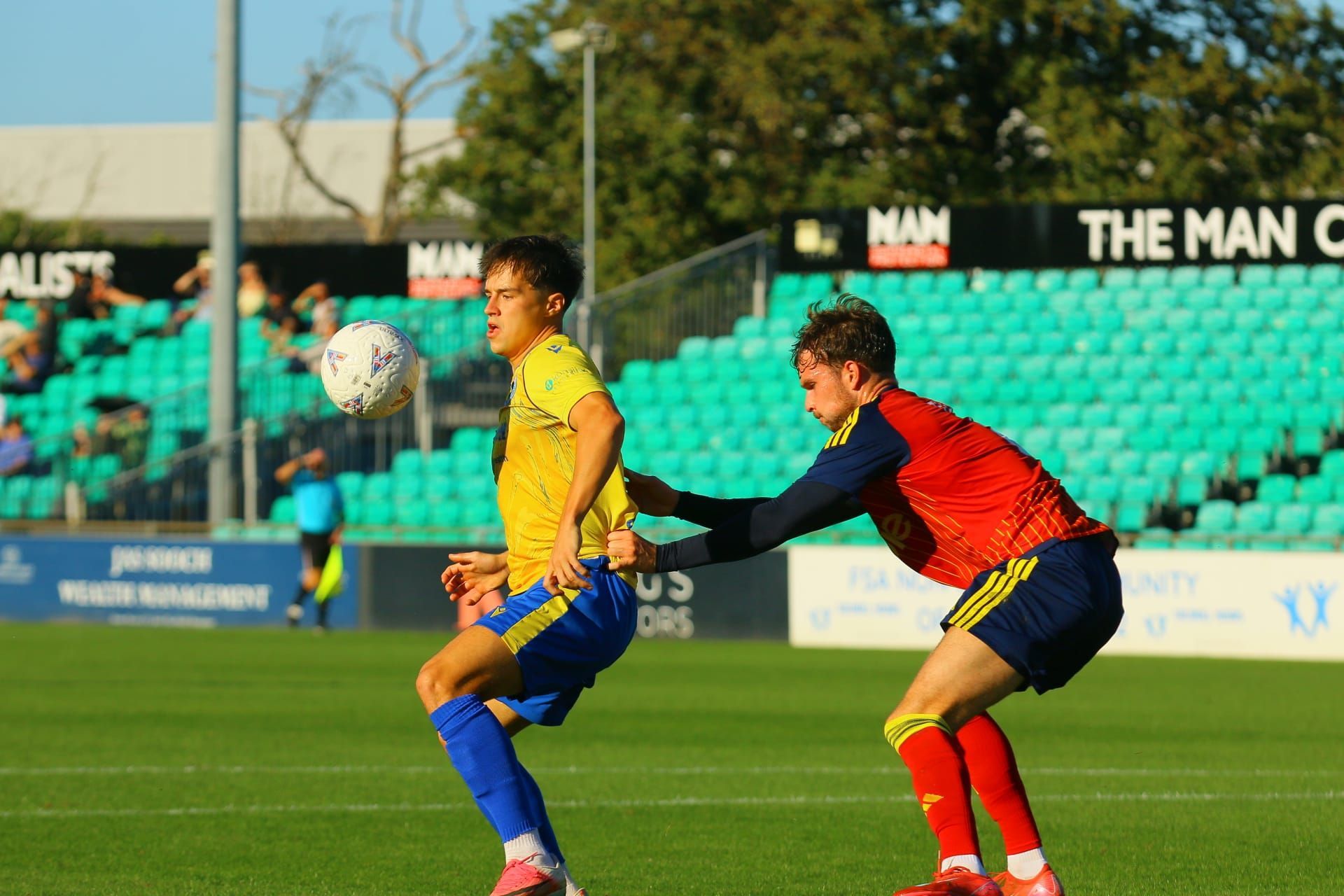
Solihull Moors were comfortably beaten 2-0 by FC Halifax at Damson Park in the Enterprise National League, as Chris Millington faced his former side. Team news Florent Hoti was given his full debut for The Moors after impressing off the bench against Woking in midweek. The midfielder came in for Ryan Woods, who went off with a knock in that game. Tyler French started his first game since returning from injury, replacing Tyrell Warren, who was serving a one-game suspension following his booking on Tuesday. Also making a welcome return from injury was Oscar Rutherford, who made a matchday squad for the first time this season, starting the game on the bench. It was a cagey start for both sides, as they struggled to keep possession for long periods. Halifax grew more into the game and had the better of the opportunities as The Moors failed to trouble the away side too much. The second half began in a similar manner, until Cruz Allen scored following a mistake in the Solihull defence. Halifax went on to score again, this time an inch-perfect free-kick from Tommy McDermott. More chances came and went for Halifax, as The Moors just couldn't find a way back into the game. The result means Chris Millington's men remain in 23rd position in the table. Kick-off Joe Sbarra had an early effort that went just wide of the post. Tommy McDermott then cut in on his left foot for the visitors, only to be denied when Jevon Mills made a cracking block. The second ball was then thundered out by the head of Chey Dunkley. With just over 10 minutes played, McDermott was again involved. A cross was played in from the left, and the Halifax winger hit the bar when unmarked at the back post. The linesman then belatedly raised his flag for offside. DISALLOWED GOAL - 16' Halifax. Another offside decision, this time the ball did end up in the back of the net, but was ruled out for the away side. Striker Conor Carty broke through and slotted past Max Metcalfe, but the celebrations were cut short when the flag went up. Cruz Allen had a powerful effort from the edge of the box blocked, before Dunkley went down with what appeared to be a thigh injury. The recent signing couldn't continue, and had to be replaced by captain Alex Whitmore. A huge let-off then followed for the home side, a sloppy pass straight to Halifax striker Carty on the edge of the penalty area was played into the box, but Scott High read the danger and cleared from near his own goal line. Another attack down the Halifax left produced arguably the best chance of the half so far. A cross was whipped in hard and low, again falling to McDermott, but the winger could only find the side netting with the goal at his mercy around 6 yards out. With Solihull been pushed further and further back, Halifax put several decent crosses into the box, Jevon Mills excellently clearing from one, before Metcalfe made two great saves. The first in particular, clawing away an effort that looked to already be past him, before a very similar one down to his right that came from a less powerful strike. Shortly after, a Halifax midfielder fired high over the bar, before McDermott curled narrowly wide, again showing the danger he posed when cutting in from the right, and onto his favoured left foot. The ball fell the nicely to Carty, who couldn't get enough on his shot inside the box, and the ball was caught comfortably by Metcalfe. In a rare Moors attack, Tyler French found himself in space on the right-hand side of the box, his cross falling just short of Wakeling who was ready to pounce. On 40 minutes, whilst trying to prevent a throw-in, Halifax's Ben Tollitt took a tumble over the advertising boards and had a seat with the away fans, giving himself a brief rest after all of his hard work in the first-half. In the 2nd minute of injury time at the end of the half, defender Alex Bardell's effort from a corner was well dealt with by Metcalfe, who palmed away his close-range header to keep the scores level at the break. Half time - 0-0 Second half An attacking substitution by Chris Millington for the start of the second half saw winger Junior Tiensia come on to replace defender Carter Pinnington. A great Jamie Andrews tackle to stop a Halifax break, set the Moors on an attack of their own, Wakeling did well with little support and won a corner. Solihull rode their luck again as Halifax somehow couldn't manage to convert a ball that was whipped in with pace, straight across the 6-yard box. The away side won a free-kick in a worrying position for The Moors, Tollitt curled low, and forced a great save from Metcalfe. The ball was recycled and then fell back to the feet of Tollitt again, who this time dragged wide from 20 yards. GOAL - 55' Halifax. A mix up in The Moors defence allowed Cruz Allen an unchallenged run through on goal and he placed calmly past Metcalfe to break the deadlock for the away side. 0-1. The Moors, trying to respond to the setback, went on an attack that ended with a French cross falling to the feet of Jacob Wakeling. The strikers hooked effort going just wide of the near post. GOAL - 60' Halifax. The visitors won a free-kick on the edge of the box when McDermott was bundled over. It was McDermott himself who stepped up to take the resulting set-piece, sending a beautiful, curling effort into the top corner with his left foot, leaving Metcalfe with no chance. 0-2. The Shaymen almost scored a third, with Carty hitting the crossbar, before Mills cleared the danger before a Halifax attacker could respond. Scott High then had a half-chance that he couldn't keep down, firing over from the edge of the box. Wakeling found some space to run into and broke through on the left, smashing his effort straight at Halifax keeper True Grant. Manager Chris Millington made a double substitution with just over 20 minutes left to play, bringing on Oscar Rutherford and Rio Shipston for Florent Hoti and Matty Carson, in an attempt to find a way back into the game. With Halifax looking increasingly dangerous, another chance went begging, this time Conor Carty diverted a cross towards goal, but Metcalfe was there again The dangerous McDermott curled over 20 yards after finding space on the right again. Substitute Rutherford, making his 150th appearance for the Enterprise National League, was looking lively on the right wing, and some nice link-up play with French put him through on the right, Rutherford's cross fell to High, who's shot was well blocked. Another burst down the wing by Rutherford followed, with our returning number 21 putting a good cross into the head of Wakeling, who could only head over. The final minutes fizzled out, with Halifax happy to see out the game and take home the 3 points, which moved them up to 13th in the table, and The Moors struggling to create any clear-cut chances. Full-time - Solihull Moors 0-2 FC Halifax. Attendance 966 (including 149 travelling fans) Moors fans, thank you for your continued support and backing of the boys in this tough period. We look forward to seeing you soon. We hope you have a safe journey home. COYM💛💙 Next up We host Newcastle U21's in the National League Cup on Tuesday 6th October at Damson Park. Kick-off 7pm. Tickets for this fixture are free, but need to be claimed using the link below - https://solihullmoorsfc.ticketco.events/uk/en/e/solihull_moors_v_newcastle_national_league_cup?version=m We're back in league action on Saturday 10th October as we face Worthing at the Sussex Transport Community Stadium. Kick-off 3pm. Travelling supporters can purchase coach tickets below - https://solihullmoorsfc.ticketco.events/uk/en/e/worthing_away_coach_travel_2627?version=m
By Kate Willetts • October 2, 2026
Solihull Moors host Halifax Town at Damson Park on Saturday. The Moors come off an emphatic 4-2 away win at Woking midweek, while Halifax were held to a 1-1 home draw with Boston on Tuesday. Andy’s Bet Club are on hand to preview all our key games for the 2026/27 season. Their site is packed with free football tips that are updated daily with expert insight. Match Preview Solihull Moors head into this fixture off the back of a 4-2 win away at Woking, in a game where they scored with every shot on target they had. Goals from Jacob Wakeling, Scott High, and a Jamie Andrews brace were enough to hand the Moors their second win of the season. Halifax were held to a 1-1 draw last time out against Boston in a game where they were comfortably the better side. Conor Carty scored Halifax’s only goal of the game after Lennon Wheeldon gave the visitors the lead in the 30th minute. Solihull’s result means they have closed the gap between themselves and getting out of the bottom four, whilst Halifax sit 15th after three league games without a win. Solihull Moors Form Guide Solihull’s 4-2 win at Woking came from just 0.61 xG to Woking’s 1.88. The Moors had eight shots with four on target, meaning Chris Millington’s side scored with every shot on target they had. Jacob Wakeling, Scott High, and Jamie Andrews all got on the scoresheet in a game where the first half saw five goals. This was the Moors' first league away win of the season, and a win on Saturday to see them on the cusp of leaping out of the drop zone after two wins in their last four league games. Halifax Town Form Guide Halifax racked up 2.11 xG in their 1-1 draw against Boston, in a game where they had a whopping 12 shots on target. They also had 57% possession, but went behind after Lennon Wheeldon gave Boston the lead. Chris Carty then equalised for Halifax with a chance worth only 0.08 xG. Ben Tollitt had the best chance of the game for Halifax with a chance worth 0.23 xG. Tactical Insight Solihull will need to replicate their shooting efficiency if they are to get a result against Halifax here. Halifax were left frustrated, having 18 shots with 12 on target against Boston and limiting their opponents to just 0.79 xG. The likes of Jacob Walking have been a constant attacking threat for the Moors this season, and despite their position in the league, have shown tendencies to post impressive xG stats in games. The Woking game was a sign that Solihull can take their chances. If they are as efficient against Halifax as they were against Woking, Chris Millington’s side could see this as a chance to get a run going. Conclusion Win on Saturday and Solihull will be on the cusp of breaking out of the bottom four. Halifax are winless in three, and a big away win couldn’t have come at a better time for Solihull. Visit Andy’s Bet Club for daily free betting tips and free betting offers from the top UK-licensed bookmakers.
By Kate Willetts • October 1, 2026
Chris Millington and his Solihull Moors team are facing an FC Halifax Town side led by their current Head Coach John McGrath at Damson Park in their latest game of the 2026/27 Enterprise National League season. A victory for The Moors would see them build momentum whilst also climbing up the fifth tier table. The Shaymen, who are the former club of Premier League winner Jamie Vardy, find themselves around the midtable region of the league table, and they know that a win would see them make ground on those above them. Millington’s side will, of course, have ambitions to prevent their opponents from securing all three crucial points. FC Halifax Town is, of course, a phoenix club. The original club was called Halifax Town Association Football Club, who were formed all the way back on 24 th May 1911. Formed at the Saddle Hotel, they played their football in the Yorkshire Combination and the Midland League before then becoming one of the founding members of the Football League Third Division North in 1921. They remained there until 1958, which was when there was a league restructuring, and subsequently they became members of the Football League Third Division. We will now fast forward to the 1970/71 season; they finished third, which was one place below promotion from the Football League Third Division. However, then in 1971/72, they were only just able to avoid relegation, doing so on goal difference after Rotherham United had lost on the final day of the season against Tranmere Rovers. However, in 1976, they were relegated down to Division Four. Then in 1993, they were relegated once again, this time to the Football Conference ahead of the following season, the 1993/94 campaign. In 1996/97, they avoided relegation under returning boss George Mullhall, which came after they had a few poor seasons and some financial problems. Then in the 1997/98 season, they had a superb campaign, winning the league title with the likes of Jamie Paterson, Mark Bradshaw, and Lee Martin in the squad. Their top goalscorer was Geoff Horsfield, who was able to find the back of the net on several occasions, with him scoring as many as 30 goals in the end. Chris Wilder was the boss when the club found themselves in the Conference again in the 2001/02 season, and in their first season back, they finished in 8 th place. In 2005/06, they finished in 4 th , but could not get promotion by losing to Hereford United in the Conference League Play-Off Final. Fast forward to 2007, The Shaymen found themselves in financial trouble again and were placed into administration by a local consortium. And, despite being deducted 10 points, they still survived relegation. They were still wound up after an appeal. Then in May 2008, things got worse for Halifax when they, following a major error, owed more than £800,000 to HMRC, with the club now more than £2 million in the red. They would cease to exist. It was also in 2008 that the phoenix club, FC Halifax Town, was formed who Solihull Moors will soon be facing once more. They were accepted to play in the Northern Premier League Division One North for the 2008/09 season. Neil Aspin was appointed manager in April 2009, and in his first season in charge, 2009/10, they had what turned out to be a very successful campaign, winning the league after amassing 100 points whilst scoring as many as 108 goals as a team in the process. In the 2010/11 season, they found themselves in the Northern Premier League, the seventh tier of English Football. This was the season when they signed Leicester City legend and former England international Jamie Vardy. They got automatic promotion to the Conference North after beating Retford United 2 – 0, also securing them the league title. Vardy then left for Fleetwood Town in the early stages of the 2011/12 season, finishing third before then losing in the playoffs to Gainsborough Trinity 3 – 2 on aggregate. Promotion to the National League was sealed in 2012/13 when, after finishing in 5 th place, they beat local side Guiseley 3 – 1 on aggregate in the playoff semi-finals before then going on to get the better of Brackley Town in the final, with the solitary goal to win the game 1 – 0 coming from striker Lee Gregory. The fifth tier was now, and still is, the highest level that FC Halifax Town has ever been, and in their first season at this level, they got all the way to the promotion playoffs semi-final, where they would lose 2 – 1 to Cambridge United. Fast forward to 2015/16, and it saw them get relegated down to the sixth tier despite the best efforts of former North Ferriby United manager Billy Heath. They were able to make an immediate return to the National League after a third place finish in 2016/17, beating Chorley 2 – 1 after extra time in the final, after having beaten Salford City 3 – 0 on penalties in the semi-finals after the scoreline was level at 1 – 1 after extra time. It was in 2018 when FC Halifax Town became full time, with Pete Wild taking over from former boss Jamie Fullarton. They lost out in the playoffs semi finals 2 – 1 to Boreham Wood in 2018/19 before a 10 th place finish the following season. The 2021/22 season was a great one for Halifax, who were able to achieve their highest ever position in the English Football Pyramid since their formation back in May 2008. They were able to finish in 4 th place, getting into the playoffs where they lost 2 – 1 at home to Chesterfield. Shortly after, Pete Wild left the club for League Two side Barrow, with Wild being replaced by the current Solihull Moors boss Chris Millington. The club reached the National League playoffs again in the 2023/24 season when they finished in 7 th place, losing 4 – 2 to the aforementioned Solihull Moors. They were then eliminated again the next season, this time losing 4 – 0 to Oldham Athletic in 2024/25. Then in June 2025, Adam Lakeland took charge as their new manager before then leaving back in April 2026, when he took charge of Morecambe after finishing in 8 th place. Current boss John McGrath was then announced as his successor in May 2026. In 2026/27, McGrath’s Shaymen will be hoping to finish in the top half, and maybe finish in the playoffs once again. In the opposition dugout – John McGrath Current Halifax boss John McGrath has been in charge ever since he took over back on 19 th May 2026, replacing Adam Lakeland in the Shaymen dugout. Before joining the team, he was in charge of National League club Buxton, where he was in charge for two years between May 2024 and May 2026, when he left for FC Halifax Town. Before that stint with Buxton, he was in charge of Mickleover, which was his first job in senior club management. He was with them for as many as 8 years, from 2016 to 2024, when he left for the aforementioned Buxton FC. McGrath also had a playing career that lasted for more than 20 years, 21 years to be exact, from 2001 to 2022. He represented the likes of Aston Villa (2001 - 2003), Dagenham & Redbridge (Loan, 2002 - 2003), Doncaster Rovers (2003 - 2005), Shrewsbury Town (Loan, 2004), Kidderminster Harriers (2005), Limerick (2005), Weymouth (2006), Tamworth (2006 - 2007), Burton Albion (2007 - 2013), York City (Loan, 2013), Alfreton Town (2013 - 2014), and finally the aforementioned Mickleover from 2015 to his retirement in 2022. Key Player – Zak Gilsenan Halifax’s key player is arguably wide forward Zak Gilsenan, with the 23 year old being their joint top goal scorer this season so far with 3, tied with Ben Tollitt. Gilsenan is a new signing for The Shaymen, having joined from Grimsby Town back on 6 th July 2026, signing a one year deal with an option of an additional year. Other clubs that Gilsenan has played for include the likes of Blackburn Rovers (2023 - 2025), the aforementioned Grimsby Town (2025 - 2026), Buxton (Loan, 2026), Gateshead (Loan, 2026), and, of course, current club Halifax Town, from July 2026. Gilsenan has also spent time as a youth player for the likes of Carramar Cougars, Sorrento (leaving in 2011), Perth Glory (2011 - 2012), FC Barcelona (2012 – 2014), Liverpool (2014 - 2019), and finally Blackburn in 2019, being promoted to their senior team back in 2023. 
By Kate Willetts • October 1, 2026
TICKETS Season Tickets Season tickets are valid for this fixture. All tickets can be purchased here . Opening times and turnstile access The car park will open at 12:00pm The box office for ticket collection will be open from 1:00pm The Main Bar and Trevor Stevens Bar will open at 1:00pm Please note that Flasks are not permitted into the stadium Hospitality/Executive Boxes Hospitality doors for this fixture will open at 12:30pm. Junior Tickets 15-year-olds and under must be accompanied by a full-paying adult on the day of the match; otherwise, U16 ticket holders may be refused entry to the venue: turning up to the match without a full-paying adult is a safeguarding issue. Young Supporter Matchday Prices The following prices will be available for all home National League fixtures during the 2026/27 season: Under-12s: £1 with a paying adult Ages 12-15: £7.50 with a paying adult Ages 16-24: £11 All supporters wishing to purchase a ticket in one of these age categories must register for the Club’s free Young Supporters Membership Scheme. If you're aged 16 or 17, you need to be part of the Young Supporters Scheme to enter the stadium on your own; otherwise, you will not be allowed to enter the stadium unaccompanied. SAFEGUARDING RE ADMISSION: Note for reference, those supporters aged 15 and under MUST be accompanied by an adult to enter the ground, i.e. the individual must be 16 or over. Matchday Entry Supporters must present their valid membership card when entering Damson Park using a young supporter ticket. Under-12s and ages 12–15 must enter through Turnstiles 1 or 2 alongside their parent or guardian. Supporters aged 16–24 must enter through Turnstile 3. Under-16s must attend with a responsible adult (at a ratio of 2 children per one adult) and will not be permitted to enter the stadium unaccompanied. Any more than two children per one adult, please email ticketing@solihullmoorsfc.co.uk in advance to organise this request. To find out more about the admission & Young Supporters Membership: https://www.solihullmoorsfc.co.uk/solihull-moors-reduces-matchday-ticket-prices-for-young-supporters REFRESHMENTS Supporters can purchase alcohol and refreshments from the Main Bar, the Trevor Stevens Suite and Forest Bar (away fans only) There will be food available at: Hot Food Bar in the old reception Terry's Burger Van Spud van GETTING HERE PARKING The Car Park is open from 12:00pm Please do not park on the Damson Parkway dual carriageway – this is a red route and parking here is strictly prohibited. Supporters will receive tickets for parking illegally, so we stress the importance of utilising the NCP Car Park and planning your journey well in advance. If fans forget to pay before leaving, they will still be able to pay via Post Pay within 24 hours of exiting the car park however this will charge them the original tariff. Failure to pay will result in a Parking Charge. To learn more, including tariffs and PostPay, please visit: https://www.birminghamairport.co.uk/parking/freeport-car-park . Any Fans using the Car park can use the code ‘MOORS26’ to receive the discounted Rate of £6 for up to 5 hours. This Code will need to be used on the Pay Machine near the exit of the Car Park. Any supporters' coaches must drop fans off at the NCP parking point, as the Damson Parkway dual carriageway is a red route. It is at the coach driver’s discretion to drop supporters off on the red route; supporters must then walk from the NCP Car Park to the stadium. Travel by Bus The X12 bus runs to the ground every 15/20 minutes from Solihull Town Centre, the NCP and Birmingham International. In night matches, this increases to every 30 minutes. Click here to view the X12 bus route, stops and full timetable . Travel by Train Solihull Railway Station is served by trains from Birmingham Moor Street and London Marylebone. The ground is situated two and a half miles away from the station in a roughly north-easterly direction. Birmingham International Station is roughly one and a half miles from the ground and is on the Euston to Birmingham New Street line. Programme The programme can be downloaded from here . Kick It Out You can report an incident of discrimination via the Kick It Out App, which can be used on iPhone and Android devices. Phone – 0800 169 9414 Twitter - @kickitout , or by contacting the organisation’s Reporting Officers on @kickitoutreport. Solihull Moors Supporters Association Click here to find out more about the Solihull Moors Supporters Association.
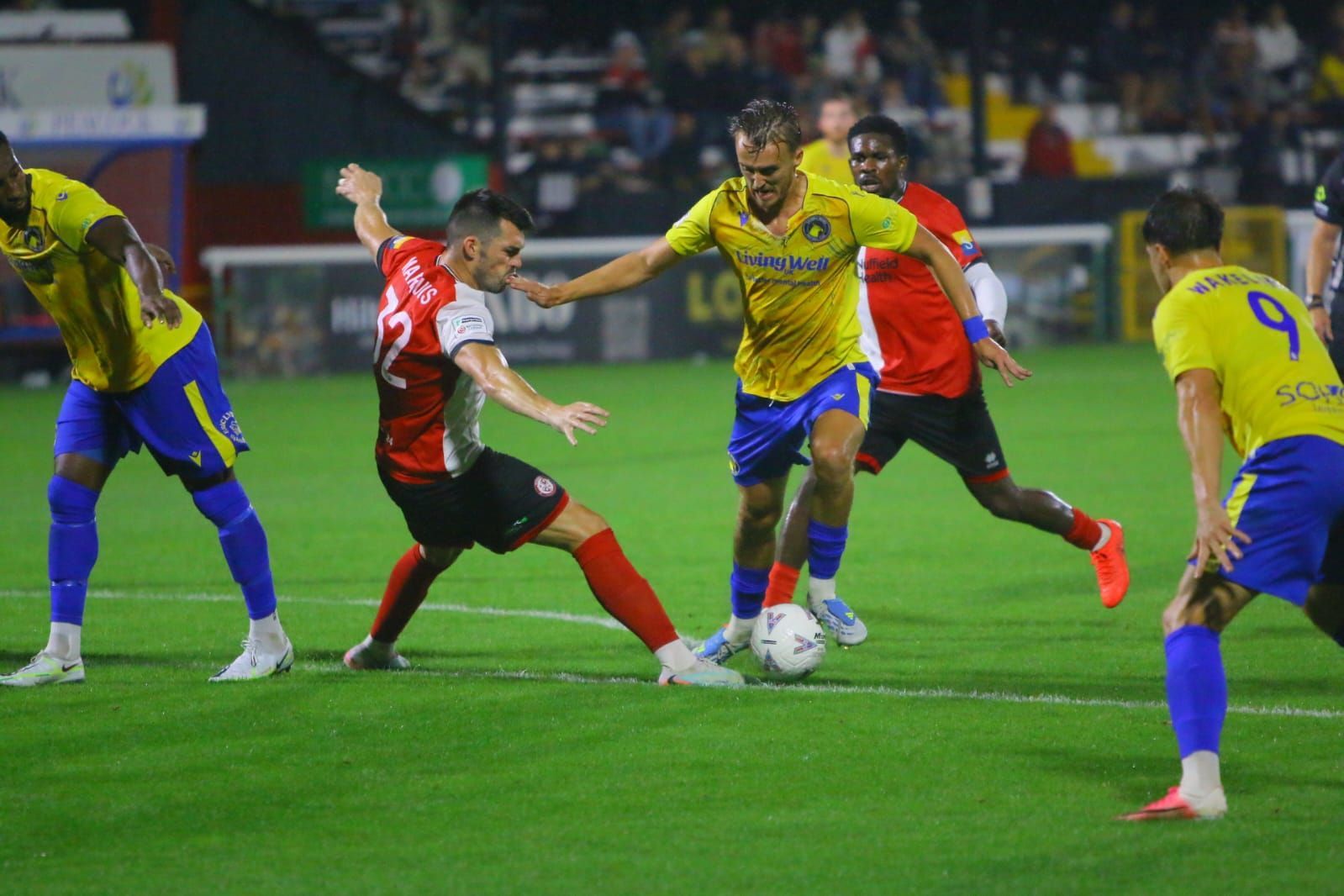
By Eddie Turner • September 30, 2026
A superb performance by Solihull Moors secured a 4-2 victory against Woking at the Laithwaite Community Stadium on Tuesday night in the National League. Two new signings were announced before kick-off, with defensive duo Chey Dunkley, and Carter Pinnington both making their debut for The Moors. Jacob Wakeling opened the scoring for Solihull, only to see his side pegged back with a fine finish from Matt Ward. John Marquis then put Woking ahead, before Jamie Andrews equalised from 20 yards with his first goal for The Moors. Scott High then curled in an exquisite finish from outside the box to send the away side in 3-2 ahead, at the end of a roller coaster first half. The second half was a much tighter affair, with Woking having defender Jaiden Putman sent off on 56 minutes, before another wonderful Andrews strike sealed the game and sent Chris Millington's men home with a huge 3 points. Kick-off A bright start to the first 45 by both sides was a sign of things to come, with Woking and Solihull testing each other's defence early on. GOAL - 6' Moors. A flicked ball by Carson was misread by Steven Turner, and fell to Scott High, who took full advantage by playing an inch-perfect pass into Wakeling, who's left-footed shot from a tight angle was too powerful for Woking goalkeeper Will Jaaskelainen, with the ball going under his body at the near post. 0-1 Down the other end, new signing Chey Dunkley was already showing exactly why he was brought to the club. His first two significant moments were a sliding block to deny a tap in, and then deflecting Ward's follow-up strike just over the bar as Woking pushed for an equaliser. Woking striker John Marquis, who looked a threat from the beginning, was almost put through on goal, but Moors keeper Metcalfe was alert to the danger, beating the Woking man to the ball on a couple of occasions. Another dangerous Woking attack followed, with Shadrach Ogie steaming down the left wing, only to see his cross blocked by the impressive Dunkley. GOAL - 23' Woking. Roy Syla won the ball in the middle for the home team, then sent Ward through on the right-hand side of the box, the Woking man found himself with time to take a couple of touches, before unleashing a thunderous, swerving shot past Metcalfe. 1-1 Immediately after the goal, High broke down the right, but his cross was just short of the on rushing Wakeling. GOAL - 25' Woking. Turner fed a ball into Kelly, which he brilliantly chipped through to Marquis, who's scuffed shot was beyond the reach of Metcalfe. 2-1 GOAL - 27' Moors. From the resulting kick-off, Millington's side put together a wonderful team move that saw almost 20 passes without the home side getting a touch of the ball. It ended up with the tenacious Andrews driving through to the edge of the box before unleashing a screamer from around 20 yards. 2-2 A penalty shout followed for Woking after some brave goalkeeping from Metcalfe again, who was quickest as Ward raced through on goal. Metcalfe came sliding out to get a vital touch, before Dunkley cleared the danger. Both players then stayed down and required treatment before play could continue. GOAL - 45' Moors. Just a couple of minutes after coming on for Ryan Woods, Florent Hoti won the ball, which then fell to Wakeling, who found High on the edge of the area, and The Moors midfielder whipped a sensational left-footed strike into the far corner to put the Midlands side into the lead again. 2-3 Second half Woking won a corner seconds into the second half, with Tyrell Warren doing well to head the ball out and away from danger. Half time sub Aiden O'Brien's header from the corner was just over the bar. With Woking searching for a goal, Warren again got a good block in, and Pinnington, also did well to get his foot in ahead of the home sides attackers a couple of times as The Moors held on, before Putman, out on the left, then cut in and had a decent effort at goal, but Metcalfe was well positioned to catch the shot. RED CARD - 56' Woking. While trying to dispossess Jaiden Putman, the Woking defender went down under a challenge by Joe Sbarra, Putman then appeared to strike The Moors midfielder, and referee Jason Richardson issued a straight red card. A huge blow for Jake Hyde's side, after starting the second half on the front foot. Sbarra received a yellow card for the initial foul. O'Brien and Shadrach Ogie looked lively for Woking, O'Brien's trickery and Ogie's pace were a constant threat. The two combined to create a chance for sealer on the edge of the box, his shot deflecting safely into the arms of Metcalfe. Defender Tyler French made a welcome. return from a long injury lay-off, replacing new-boy Pinnington who was solid and assured on his Moors debut. GOAL - 77' Moors. Some great determination again by Hoti to win possession in the middle of the park, who then played a one-two with Wakeling, before having an effort blocked. The ball then fell nicely to Matty Carson, who rolled across to Andrews, and the midfield man calmly slotted into the back of Jaaskelainen's net to score his second of the game against his former side. Andrews, looking for a hat-trick, tried his luck from distance, but the strike was deflected wide for a corner. From the corner, Jevon Mills saw a header go just wide of the post. Another chance for the Moors to score a fifth followed, Hoti and fellow sub Junior Tiensia combined on the edge of the box, with the latter whipping in a low cross that Wakeling was agonisingly close to getting a touch on. Although the striker may possibly have been flagged for offside had the ball ended up in the net. Another substitute, Rio Shipston then tried his luck from long range after a fast Moors break. Woking continued to huff and puff, but ultimately found the Solihull defence, and Metcalfe, too difficult to crack. The Moors keeper brilliantly tipped a powerful Harrison Sohna's drive onto the post in injury time, before Marquis had an effort trickle inches wide as Millington's side held on for a valuable win on the road. Full time - Woking 2-4 Solihull Moors. Man of the match - Jamie Andrews. All in all, a terrific result and performance away from home against a tough Woking team, who only a few days ago put 5 goals past Carlisle. Hopefully the result can provide a platform to build on, as Chris Millington and his squad aim to climb our way back up the table. A massive thank you to each and every one of the 35 fans that travelled to Woking. The level of commitment to make a 230+ mile round trip for our club midweek is impeccable. Hopefully those 3 points made it worthwhile, and you have a safe journey home💛💙 Next up Another home double header as Damson Park plays host to FC Halifax on Saturday 3rd October, 3pm kick-off in the Enterprise National League, followed by a National League Cup tie against Newcastle U21's on Tuesday 6th October, 7pm kick-off. Tickets for FC Halifax can be purchased on the link below - https://solihullmoorsfc.ticketco.events/uk/en/e/solihull_moors_v_fc_halifax_town2627?version=m COYM💛💙 Written by Scott Cattell

By Kate Willetts • September 30, 2026
Football is so much more than ninety minutes on a pitch. It’s about belonging, finding your voice, and discovering that your physical boundaries don't define your potential. When my son Ted first joined the Solihull Moors Foundation Ability Counts sessions at five years old, the world was navigating the height of COVID-19. Ted lives with hemiplegia, a form of Cerebral Palsy that affects half of his body. Finding an environment where he was not only accommodated, but truly understood and encouraged, was vital. Six years later, Ted has just turned 11, and looking back on his journey with Solihull Moors shows how transformative inclusive sport can be. More Than Just a Game: Confidence, Community, and Community Spirit Over the last six years, Ted’s weekly sessions with Moors haven't just developed his footballing skills—they have reshaped his confidence. Through continuous training sessions and local tournaments, he has built lasting friendships with teammates who understand the unique challenges and triumphs of living with a disability. The inclusive, uplifting culture at Solihull Moors provided Ted with a safe space to test his limits, fall in love with the game, and dream big. A Spark Lit at the CP Euros The pivotal moment in Ted's journey came last year at the CP Euros. Watching elite players with Cerebral Palsy compete at the highest level, and meeting the England national team in person, showed Ted exactly what was possible. Inspired by seeing athletes like him represent their country, Ted took a huge step: trialling for the England Para-Pathway. Thanks to the strong foundation he built at Moors, Ted was accepted onto the scheme. Today, he trains at the regional Para-Pathway hub at Aston Villa’s indoor facility, working hard every week toward his ultimate goal: one day putting on the England shirt and representing his country. A Heartfelt Thanks to Solihull Moors Foundation None of this would have been possible without the unwavering commitment, care, and belief of everyone involved with the Solihull Moors Foundation. Special recognition must go to Scott Langford. Scott’s dedication, patience, and ability to see the potential in every child who walks onto the pitch have been instrumental in Ted's growth, both as a player and as a young boy. Coaches like Scott don't just teach football; they change lives. Get Involved: Give Your Child the Chance to Play. If you are a parent of a child with a physical disability, neurodivergence, or additional needs, know that there is a place where your child can thrive. The Solihull Moors Foundation Ability. Counts sessions offer an inclusive, supportive, joyful environment where every player can shine. Ted’s journey started with a single session at five years old. Today, he’s chasing his dream of playing for England.
By Kate Willetts • September 29, 2026
Solihull Moors are delighted to announce the signing of experienced defender Chey Dunkley on loan from Chesterfield until 26th December. The 34-year-old centre-back arrives at Damson Park with more than 400 senior appearances across the EFL and Non-League game.  Born in Wolverhampton, Dunkley began his career within Crewe Alexandra’s Academy before gaining senior experience with Hednesford Town and Kidderminster Harriers. His performances earned him a move to Oxford United, where he made 78 appearances and helped the club secure promotion to League One during the 2015/16 season. Dunkley later joined Wigan Athletic and played a key role as the Latics won the League One title in 2017/18. He made more than 100 appearances during his three seasons at the club before going on to represent Sheffield Wednesday and Shrewsbury Town. The 6ft 2in defender joined Chesterfield following two seasons with Shrewsbury and brings extensive experience, leadership and a considerable goal threat from defence, having scored more than 40 times during his senior career. Speaking about his arrival, Moors boss Chris Millington said: “ Chey brings a huge amount of experience and leadership to the group. He’s a commanding defender who will give us real strength at the back, and we’re delighted to have him with us.” Welcome to the Moors, Chey! 💛💙 The deal is subject to the relevant league and FA clearances.
By Kate Willetts • September 29, 2026
Solihull Moors are delighted to announce the signing of defender Carter Pinnington on loan from West Bromwich Albion until December 26th. The 19-year-old centre-back arrives at Damson Park having joined the Baggies from Liverpool on a three-year deal ahead of the 2026/27 campaign. Pinnington progressed through Liverpool’s Academy after joining the club at Under-7 level and went on to represent the Reds across several age groups. The commanding defender made 19 Premier League 2 appearances for Liverpool’s Under-21s during the 2025/26 season, while also gaining experience in the UEFA Youth League and EFL Trophy. Pinnington was also included in Liverpool’s senior squad for their Carabao Cup fixture against Crystal Palace in 2025 and has represented England at youth international level. Speaking about his arrival, first-team manager Chris Millington said:  “Carter is a talented young defender who has developed within an excellent academy environment. He gives us another strong option at the back, and we’re looking forward to working with him during his time at the Club.” Welcome to the Moors, Carter! 💛💙 The deal is subject to the relevant league and FA clearances.

Show More